

A few years ago a story made the rounds that a “lost song” from The Muppet Christmas Carol had been found. The song was “When Love is Gone,” sung by Meredith Braun as Belle. Fans took to social media to express confusion, saying that they remembered that song being in the film already. Many went on to say that the movie was better off without that number, insisting that the slow, sentimental song (which didn’t even include any Muppets!) was a show-stopper, and not in the good way.
I’m going to explain the complicated history of “When Love is Gone,” and why it’s actually essential to The Muppet Christmas Carol.
The tune was always supposed to be part of the movie, with its intended place occurring about 45 minutes into the film when the Ghost of Christmas Past caps off her guided tour of Ebenezer Scrooge’s formative years by making him revisit the day his fiancée, Belle, broke off their engagement. Not long before the movie’s 1992 theatrical release, Disney exec Jeffrey Katzenberg observed fidgety kids in test screenings during that scene. He insisted that the song be cut, stating that it would lose the younger audience members. Brian Henson and the rest of the creative team pushed back, but they found themselves at a stalemate.
Eventually, a compromise was reached. “When Love is Gone” would be, well, gone, from the theatrical release, to assuage Katzenberg’s concerns about restless rugrats. However, when the movie was released on VHS, it would be restored to its proper place so audiences could experience it as intended. So if you remember the song from your youth, you’re probably remembering watching it on videocassette in the comfort of your own home sometime in the 1990s.
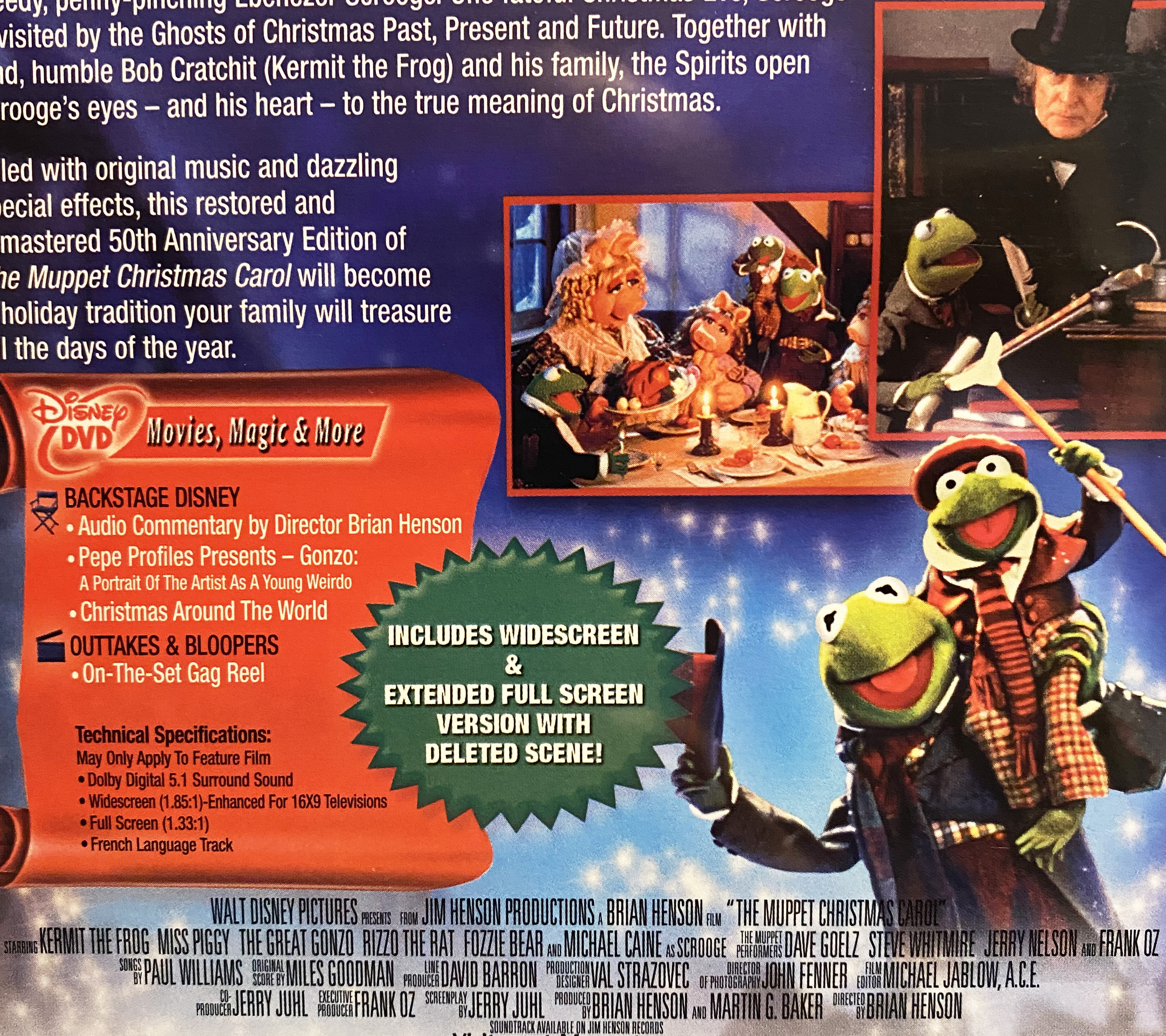
In the early 2000s, The Muppet Christmas Carol was released on DVD. As was not uncommon in this era, the DVD included both “full screen” and “widescreen” versions of the film. (DVDs were still relatively new and most TVs were 4:3 rather than 16:9. Audiences were used to home media releases being modified to fit their screens, so most movies had the picture cropped on the sides via the notorious practice of “pan and scan.”) Here’s where it gets interesting. The “full screen” version was the same as the VHS release, so it included “When Love is Gone.” The “widescreen” version was the theatrical cut, so it had the song omitted!
Check out the back of the DVD release, which touts the full screen version as including a “deleted scene!”
To make things even more complicated, a rendition of “When Love is Gone,” sung by Martina McBride, plays over the end credits no matter which version you’re watching!
Why didn’t they add the song back into the widescreen version too? This is where the song being “lost” comes in. It was the original widescreen version of the scene that had gone missing. And, as the “full screen” format in general began to fade from popularity, so too did the version that included the song. Surely any future re-releases would be of the theatrical version going forward.
It wasn’t until 2020 when Disney went back to the original negatives to prepare a possible 4K release that an additional reel of film was discovered. Brian Henson was brought in to see if it was anything that would be useful for the re-release. Lo and behold, it was the original footage of “When Love is Gone.” They quickly went to work on restoring and reinserting it back into the movie.
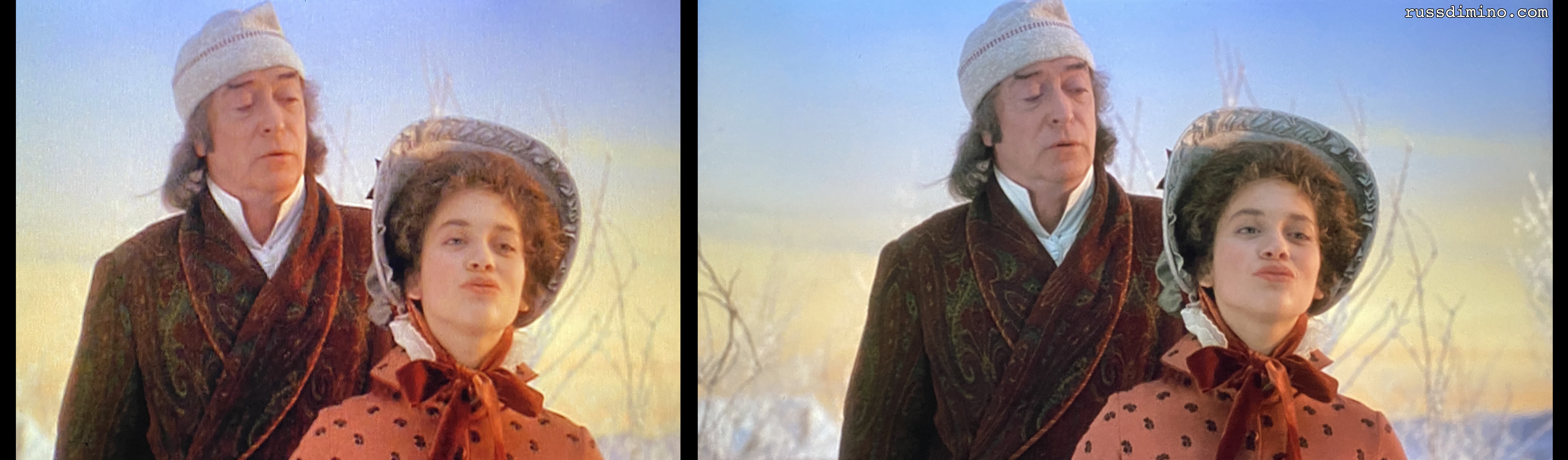
So where can you watch the complete version? The most recent Blu-ray release is still the theatrical cut, sans song. The only place you can currently watch The Muppet Christmas Carol, in its highest quality widescreen format with “When Love Is Gone” included, is on Disney Plus – but even there it’s a bit hidden. If you just click “Play” on the movie, you’ll get the truncated version with no song. Instead, click Extras. There’s an option to watch the song on its own, or, to watch the “Full Length Version” which includes the song back in its proper place.

So why does the song matter? It’s slow, it’s sad, it’s sentimental, and it must be superfluous if it was able to be cut without impacting the film, right? Wrong. It’s actually crucial to Scrooge’s character arc, and the movie doesn’t work nearly as well without it.
In the theatrical cut, we observe young Ebenezer Scrooge with Belle on a park bench on Christmas Day. Belle points out that it’s been another year and they still aren’t married. Scrooge attempts to justify this by saying that business continues to be poor and they can’t afford a wedding right now. Scrooge insists that he does love Belle. “You did, once,” she replies. Then she gets up and walks away from him. Cut to Rizzo the rat bawling his eyes out, and the modern-day Scrooge begging the Ghost of Christmas Past not to show him any more of this. It’s an extreme reaction to what we’ve just seen and does not feel at all earned. We can read between the lines that they broke up, but it’s only implied by the brief conversation. It certainly doesn’t carry the weight that would justify the reactions of Rizzo or Scrooge.
In the version with the song, the scene goes on as Belle lyrically laments:
There was a time when I was sure
That you and I were truly one
That our future was forever
And would never come undone
And we came so close to being close
And though you cared for me
There’s distance in your eyes tonight
So we’re not meant to be
Meredith Braun’s voice is gentle yet powerful, conveying sorrow but with a sense of conviction. It’s a compelling performance. As Belle sings, Young Scrooge approaches her several times, trying to touch her arm or put a hand on her shoulder. Each time she turns and walks farther away from him.
Old Scrooge, though he only exists in ghost form and cannot be seen or heard by young Belle, stands beside her and joins her in singing. It’s the first time we’ve heard Scrooge sing. Michael Caine purposely doesn’t match Ms. Braun note for note. His timing is a little off from hers; he is about a half a beat or so behind her.
“And yes, some dreams come true,” the song goes. “And yes, some dreams fall through.” Scrooge stumbles over this lyric. He gets choked up and starts to cry. That line got to him. We’ve found a moment that he regrets. There is a consequence to his actions, and we can see that he feels it. Now, the fact that Rizzo was moved to tears makes sense.
The scene is a turning point for both Young Scrooge and Old Scrooge.
Before this, everything we had seen of Young Scrooge indicated that he didn’t understand or particularly care about Christmas, but he didn’t seem like he hated it. We saw him as a boy, using the Christmas holiday to catch up on his studies at boarding school. We saw him as a young adult, poring over the books at Fozziwig’s Rubber Chicken Factory and questioning why his boss would waste money on a party. But it’s not until after his split with Belle that he seems to truly despise the holiday, wishing ill upon anyone who celebrates it.
Old Scrooge changes as well after seeing this flashback. Prior to this we don’t see an ounce of remorse in him. Seeing the Marley Brothers spooked him, and he was surprised and amazed at seeing the sights and sounds of his past. But nothing seemed to really get through to him before this moment. He was skeptical, bitter, and kind of annoyed at having to go through this time-traveling nonsense in the first place.
Once he has re-experienced his breakup with Belle, his attitude is different. The next spirit he meets, the Ghost of Christmas Present, asks him, “Have you ever noticed that everything seems wonderful at Christmas?”
For the first time, Scrooge doesn’t answer with a “Bah, humbug!” or other expression of disgust. Instead, he looks a bit ashamed. He hesitates. Then he admits, “In all honestly, spirit, no. Perhaps I’ve never understood about Christmas.”
The ice around his heart has been chipped away a bit. For the first time, the adult Scrooge is willing to concede that maybe Christmas is something he just doesn’t get. That maybe, just maybe, he’s been in the wrong.
The song is reprised at the end of the movie, when Scrooge, seated at the head of the Cratchit family table, leads the whole town in “The Love We Found.” It’s an emotional coda that harkens back to the day he lost his love. It’s a total tonal contrast between the moment that left Scrooge bitter and broken, and the day he allowed himself to accept and be accepted by the people around him. The emotional high of “The Love We Found” is not nearly as poignant when it doesn’t have that juxtaposition with “When Love is Gone.”
It’s getting to be that time of year when we all put on our favorite Christmas movies as we wrap presents, drink eggnog, and get into the spirit of the season. If The Muppet Christmas Carol is on your to-watch list, I’d encourage you to watch it with “When Love is Gone” this year. You might just see the story of Scrooge’s journey a little differently.
After all, wherever you find love, it feels like Christmas.
Russ Dimino is the author of Spilling My Guts: A Crohn’s Chronicle.
 Despite Reality